
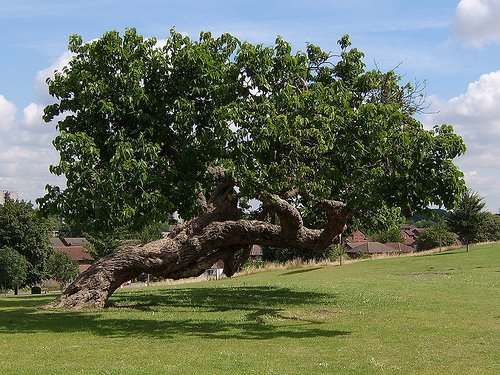
I have been thinking a lot about Mulberry trees the past couple of days—I’m not familiar with them because I grew up in Oregon and don’t remember seeing any growing there. So I looked up a couple of websites to learn about them, and here are some things I found out: mulberry trees bear fruit that resembles blackberries and the juice of that fruit is notorious for staining everything it touches. Also, fallen, decaying trees can rejuvenate to start new trees, dormant buds can germinate, and fallen trees with exposed roots can continue to grow. (Information I learned at botany.com)
So, why mulberry trees? It has everything to do with something Jesus said, “If you have faith as a mustard seed, you can say to this mulberry tree, ‘Be pulled up by the roots and be planted in the sea,’ and it would obey you” (Luke 17:6 NKJV).
I personally do not know any mulberry trees that bother me so much that I need them to plant themselves in the sea, or in fact be sent to their death; however, there are some long-held beliefs, attitudes, and habits that have deep roots in my soul and they need uprooting.
Every one of us has been given a measure of faith (Romans 12:3), and faith has the potential of increasing (2 Corinthians 10:15); therefore, having faith the size of a mustard seed is well within the grasp of every person—and for many, that seed has sprouted and grown as we have spent time with our Father in prayer, and in allowing His Word to infiltrate our lives.
The characteristics of the mulberry tree that stand out in my mind are, even when the tree is gone, the stain of the fruit may remain; also, if any part of the tree remains, it can take root and grow again.
Whether it is sin we have committed or violations against us, most people recognize that sin stains our souls. By God’s grace, He forgives our sins and cleanses us from all unrighteousness when we come to Jesus in repentance (1 John 1:9); however, I believe soul wounds remain from rebellious choices and disobedience, as well as from childhood trauma, past experiences, and twisted belief systems. Of course, the first step in removing the stain of sin is repentance and receiving forgiveness from our Savior. The Word also instructs us to forgive others for their offenses and violations against us—not so easy to do, but necessary to receive our Father’s forgiveness (Matthew 6:14, 15).
We also have the amazing glimpse into the future by an Old Testament prophet: “’Come now, and let us reason together,’ says the Lord, [How gracious is the fact that God, the One who created and controls all that is, wants to have a discussion with us!] “Though your sins are like scarlet, they shall be as white as snow; though they are red like crimson, they shall be as wool’” (Isaiah 1:18). The beauty of that promise is that God not only removes sin from our lives, but He also removes the stains left behind.
The disciples requested of Jesus, “Increase our faith!” and he told them about the mulberry tree. He went on to tell them a story:
“And which of you, having a servant plowing or tending sheep, will say to him when he has come in from the field, ‘Come at once and sit down to eat’? But will he not rather say to him, ‘Prepare something for my supper, and gird yourself and serve me till I have eaten and drunk, and afterward you will eat and drink’? Does he thank that servant because he did the things that were commanded him? I think not. So likewise you, when you have done all those things which you are commanded, say, ‘We are unprofitable servants. We have done what was our duty to do’” (Luke 17:7-10).
This is such a deep contrast between faith that accomplishes much, and duty which demands much but offers nothing—we are but unprofitable servants if we just do what is expected of us. I admit that I have felt a sense of futility about this parable because I did not recognized it in the context of Jesus’ teaching about faith. However, our relationship with God changes in Jesus because He assures us, “No longer do I call you servants, for a servant does not know what his master is doing; but I have called you friends” (John 15:15). It gets even better! “For you did not receive the spirit of bondage again to fear, but you received the Spirit of adoption by whom we cry out, ‘Abba, Father.’ The Spirit Himself bears witness with our spirit that we are children of God, and if children, then heirs—heirs of God and joint heirs with Christ” (Romans 8:15-17).
Sometimes, by discipline and strength of will we can make changes in our lives—but not root changes in those places where sin causes trees to grow. It is through faith, not duty, that we become friends and children of God. …and it is through faith that we sit at the table with our Father instead of standing at attention as a servant. It is the Spirit of the Lord who transforms our lives into the glorious image of Christ (2 Corinthians 3:18); and we can be confident that the work He has begun in us, He will bring to completion in His perfect design (Philippians 1:6) – It is God who makes us complete, and it is He who is working in our lives what is well pleasing in His sight (Hebrews 13:21).
Do we serve Him? Oh, yes we do! Because we can do no less for the one who loves us and gave His life for us. We also know what pleases Him—our faith; because “without faith it is impossible to please Him, for he who comes to God must believe that He is, and that He is a rewarder of those who diligently seek Him” (Hebrews 11:6). And we serve others – “For you, brethren, have been called to liberty; only do not use liberty as an opportunity for the flesh, but through love serve one another. For all the law is fulfilled in one word, even in this: ‘You shall love your neighbor as yourself’” (Galatians 5:13, 14).
 suemariesblog