We visited Tel Hazor on day three of our trip to Israel and I hoped to write about the experience before Easter because of the Canaanite gods that were worshipped there. Our guide referred to the female goddess, Ashtoreth—a god of fertility—sharing with us that Ashtoreth is a root of the word Ishtar (an ancient Canaanite god), which is a root of the word Easter. If you do a search on the origins of Easter, you will also see mention of “Eastre” or “Eostre”, a Saxon goddess of fertility.
I figured that I had the basis of a great blog to post right before Easter, or Resurrection Sunday, if you will. But with a lot of study, it didn’t come out quite the way I thought it would.
But firstlet me tell you a bit about Hazor…
The Holy Spirit instructed the children of Israel through Moses, “When the Lord your God brings you into the land which you go to possess, and has cast out many nations before you…seven nations greater and mightier than you, and when the Lord your God delivers them over to you, you shall conquer them and utterly destroy them. You shall make no covenant with them nor show mercy to them…. But thus you shall deal with them: you shall destroy their altars, and break down their sacred pillars, and cut down their wooden images, and burn their carved images with fire.” (Deuteronomy 7:1-2, 5)
“For you are a holy people to the Lord your God; the Lord your God has chosen you to be a people for Himself, a special treasure above all the people on the face of the earth.” (Deuteronomy 7:6)
God commissioned Joshua to lead the Israelites across the Jordan River into the land of Canaan with these words, “Now therefore, arise, go over this Jordan, you and all this people, to the land which I am giving to them—the children of Israel. Every place that the sole of your foot will tread upon I have given you, as I said to Moses…. No man shall be able to stand before you all the days of your life; as I was with Moses, so I will be with you. Be strong and of good courage, for to this people you shall divide as an inheritance the land which I swore to their fathers to give them.” (Joshua 1:2-3, 5-6)
After some victories, tempered by a defeat, a group of kings decided that the Israelites must be stopped so they gathered together an army to fight against God’s people:
“And it came to pass, when Jabin king of Hazor heard these things, that he sent to Jobab king of Madon, to the king of Shimron, to the king of Achshaph, and to the kings who were from the north…” [from every direction]. “So they went out, they and all their armies with them, as many people as the sand that is on the seashore in multitude, with very many horses and chariots. And when all these kings had met together, they came and camped together at the waters of Merom to fight against Israel.
“But the Lord said to Joshua, ‘Do not be afraid because of them, for tomorrow about this time I will deliver all of them slain before Israel’…. And the Lord delivered them into the hand of Israel, who defeated them.
“Joshua turned back at that time and took Hazor, and struck its king with the sword; for Hazor was formerly the head of all those kingdoms. And they struck all the people who were in it with the edge of the sword, utterly destroying them. There was none left breathing. Then he burned Hazor with fire.” (Joshua 11:1-2, 4-7, 10-11)
Control of Hazor jostled back and forth between the Canaanites and the Israelites several times, with another dramatic takeover of the city by the Israelites during the time of the judges (Judges 4-5). Later on, Solomon rebuilt the city: “And this is the reason for the labor force which King Solomon raised: to build the house of the Lord, his own house, the Millo, the wall of Jerusalem, Hazor, Megiddo, and Gezer.” (1 Kings 9:15)
Hazor was eventually captured and destroyed by the king of Assyria.
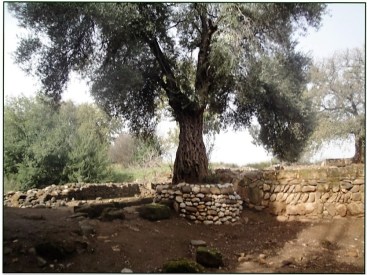
Walking through the ancient ruins of Hazor, we saw evidence of the cultic high places where the Canaanite gods, Baal and Ashtoreth were worshipped—the reason God’s protection was lifted, the Northern kingdom of Israel was attacked and enslaved, and this city, along with others, were destroyed.
“High places” in scripture refers to elevated areas where altars, along with other cultic symbols, were erected to worship idols; where they “secretly did against the Lord their God things that were not right, and they built for themselves high places in all their cities, from watchtower to fortified city. They set up for themselves sacred pillars and wooden images on every high hill and under every green tree. There they burned incense on all the high places, like the nations whom the Lord had carried away before them; and they did wicked things to provoke the Lord to anger, for they served idols, of which the Lord had said to them, ‘You shall not do this thing.’” (2 Kings 17:9-12)
Although most of us are not remotely inclined to elevate or worship the idols of long ago, there are some characteristics of Baal and Ashtoreth worship prevalent in the attitudes and devotion of many people nowadays.
The desire for security and provision: Rain is essential for crop growth, and becomes critical in such a dry land. Baal and Ashtoreth were gods of fertility and were worshipped in hopes that they would show favor and bless the land. I can recall many times that I felt I had to “take matters into my own hands” instead of waiting on God, seeking His guidance, and trusting His provision—often it is so much easier to elevate our own ingenuity or strength instead of trusting our Father in heaven to direct our paths! And sometimes it is easier to respond with fear in those moments when we may be experiencing dire circumstances or spiritual drought, looking for any sort of solution besides falling on our faces, in faith, before the throne of God.
Pandering to the lusts of the flesh: Another profound characteristic of idol worship involved sexual immorality and perversion. Without identifying specific gods, sex has become a “high place” in the lives and attitudes of this world’s civilizations; and sadly, numerous churches and many who call themselves Christians are approving and adopting idolatrous practices, making sex their god. And I cannot write about this without recognizing that what most consider an appalling pagan practice that occurred millennia ago, child sacrifice (“And they caused their sons and daughters to pass through the fire…” 2 Kings 17:17), continues on in abortion clinics all over the world.
So am I concerned about Easter bunnies and hiding Easter eggs (also symbols of fertility in past traditions) for my grandkids? …not as much as who or what, apart from the Risen Lord, is being elevated in my life. Paul’s response to the questions and concerns about eating meat offered to idols in the Corinthian church reflects my approach to what some consider pagan traditions: “Therefore concerning the eating of things offered to idols, we know that an idol is nothing in the world, and that there is no other God but one. For even if there are so-called gods, whether in heaven or on earth (as there are many gods and many lords), yet for us there is one God, the Father, of whom are all things, and we for Him; and one Lord Jesus Christ, through whom are all things, and through whom we live…. But beware lest somehow this liberty of yours become a stumbling block to those who are weak…. Therefore, if food makes my brother stumble, I will never again eat meat, lest I make my brother stumble.” (1 Corinthian 8:4-5, 9, 13)
“There are many gods and many lords” in this world—and it is up to each of us to decide which One or one(s) we are going to serve!
 suemariesblog