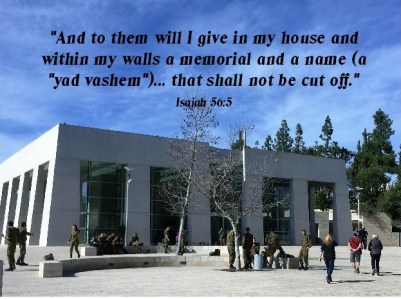
 My intention was to share experiences from my trip to Israel pretty much in the order that they happened, but a few things and sleepless hours the other night thinking about Yad Vashem, the world holocaust center in Jerusalem, changed that for me—those few things were a television show my daughter and I watched, a child’s movie we watched with my granddaughter, and Lent, which started this past week.
The episode of the television show (Foyle’s War) we were watching was set at the end of World War II and addressed the issues of the continuing fear and hatred of the Jewish people in England after the war, the return of many Jews to Palestine, and the conflicts they faced there. The British army withdrew from Israel and the State of Israel was established on May 14, 1948.
The movie we watched with my granddaughter was a remake of the musical “Annie”. We were hesitant to rent it, yet when we watched it with Eugenie, we were so glad we did—it was a lot of fun and was not at all what we expected. …and that is where we so often have problems—our expectations, and our beliefs about ourselves and others. Sadly, even after Auschwitz, Dachau, and Buchenwald (to name just a few of the concentration camps) were closed at the end of the war, the prejudice, fear, and hatred continued on in the minds and hearts of many people.
Writing about our visit to the holocaust center is not easy—and I am glad, because I don’t ever want talking or writing about such horrors to ever become easy or just a recounting of facts. I confess that it was overwhelming to see the piles of shoes of victims, the personal belongings stolen from the Jewish people, the instruments for “measuring” physical characteristics in attempts to classify hatred and murder, the faces of victims—and the numerous other reminders from the past. A pictorial and chronological accounting of the events, along with physical reminders of the atrocities of Nazi Germany weaved a pathway through time, reminding us that what happened in the past century did not happen overnight—it was a journey towards evil. And if we don’t confront evil, if we suppress attitudes of hatred and prejudice in our hearts, our homes, and our societies, we will be doomed to repeat the wickedness of the past.
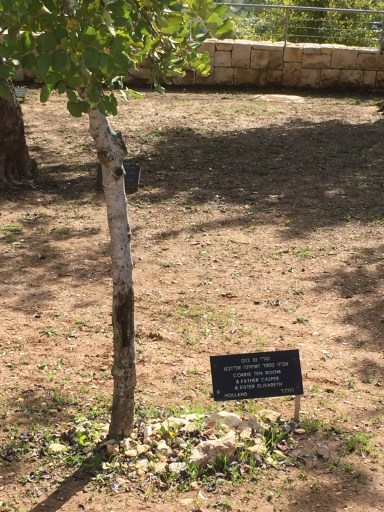
The Avenue of Trees is a moving tribute to “The Righteous Among the Nations”—non-Jewish rescuers of Jews during the holocaust. It was both encouraging and a solemn experience to walk down the avenue reading the names by trees planted in the memory of those who were willing to risk their own lives to save Jewish lives—some familiar names like Oskar Schindler and Corrie Ten Boom stood out to me. May we always have the courage that these people showed in standing with the persecuted, opposing evil!
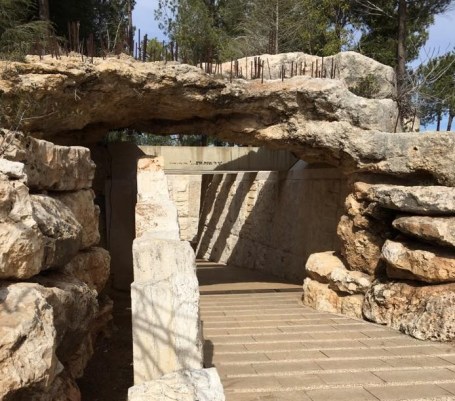
The children’s memorial, commemorating the lives of approximately 1.5 million children murdered during the holocaust is a soul-wrenching exhibit created in an underground cavern. Exposed rebar sticking up over the entrance to the exhibit stands as a stark reminder of the generation of children that did not have the opportunity to build on the foundations of the past. Throughout the memorial, candle light is reflected in darkness to represent millions of stars as the names of the children, their ages, and counties of origin are read—I don’t think I saw any dry eyes at the exit.
And Lent.
I don’t really know much about Lent other than to consider it a religious, “Catholic” custom, not really something Protestants do. But this year my daughter suggested giving up desserts for Lent. To be honest, our motives have a lot to do with losing weight and food management rather than for any sort of spiritual reasons—just another attempt to use what may be considered a spiritual discipline to accomplish a personal goal. But I thought I would look up some information about Lent to try to understand its purpose.
Lent begins on Ash Wednesday and extends for the 40 days leading up to Easter—it is based on Jesus being led into the wilderness by the Holy Spirit, where he fasted and prayed for 40 days, while being tempted by Satan. For Christians nowadays, it is an opportunity to refocus our attention by fasting, prayer, and cutting out some of the things in our lives that distract us from our relationship with God.
Lent is also a time for humbling ourselves in repentance, though we don’t readily recognize our need to do so. This admonishment is written to Christians: “Therefore submit to God. Resist the devil and he will flee from you. Draw near to God and He will draw near to you. Cleanse your hands, you sinners; and purify your hearts, you double-minded. Lament and mourn and weep! Let your laughter be turned to mourning and your joy to gloom. Humble yourselves in the sight of the Lord, and He will lift you up” (James 4:7-10).
This is what a television show, a child’s movie, and Lent have to do with each other—they served as reminders that even though the appearance and actions of evil may be hidden or eliminated, unless hearts are changed through humility and repentance, unless we recognize and bring our attitudes of criticism, condemnation, and prejudice to the throne of God, we run the risk of repeating the past. Let us be careful to listen to what our inner voices are saying, eager to respond to the Holy Spirit, and quick to acknowledge His conviction.
“When I shut up heaven and there is no rain, or command the locusts to devour the land, or send pestilence among My people, if My people who are called by My name will humble themselves, and pray and seek My face, and turn from their wicked ways, then I will hear from heaven, and will forgive their sin and heal their land.”
(2 Chronicles 7:13, 14)
 suemariesblog
Excellent blog, Sue.
thanks, Kelley 🙂